Indexed Universal Life insurance (IUL) offers powerful benefits when structured properly. From tax-free income in retirement to market downside protection, it’s no wonder more people are turning to IULs for long-term financial planning. But just like any financial tool gaining popularity, IULs have attracted their share of bad actors.
If you’re considering a policy, it’s critical to know how to protect yourself from misleading pitches, improper structuring, and outright scams. When it comes to your money and future, there’s no room for guesswork.
Understanding how to stay safe means being informed, asking the right questions, and partnering with professionals who are transparent and knowledgeable. This blog will walk you through common IUL scams, red flags to watch for, and how you can confidently move forward with your financial strategy.
Misleading Return Projections
One of the most common IUL scams involves inflated projections. Some agents might show you illustrations with sky-high returns, giving the impression that your cash value will grow at a guaranteed 8% to 10% every year. That’s simply not how these products work. While IULs are tied to market indices like the S&P 500, you don’t actually invest in the stock market. Your growth is typically subject to participation rates, caps, and spreads, all of which can limit your upside. And during market downturns, your policy can earn nothing.
If someone promises guaranteed double-digit returns, that’s a red flag. Reputable professionals will help you understand realistic projections, often based on historical averages and current market assumptions. The right illustration should include best-case, worst-case, and middle-ground scenarios, not just the “rosy” version designed to close a sale.
Overfunded vs. Underfunded
Another trap lies in improper policy structuring. IULs can be tailored for maximum cash growth, legacy planning, or a mix of both. But when an agent pushes a policy designed to earn the highest commission rather than what’s best for you, it can backfire quickly.
An underfunded policy, for example, may lapse early or never build sufficient cash value. On the flip side, overfunding it without the right structure may trigger tax consequences by converting your policy into a Modified Endowment Contract (MEC).
If you’re not sure how your policy is being structured (or why), it’s time to press pause. Ask about how the death benefit is set, how premiums compare to the IRS’s guideline levels, and whether your policy is designed for maximum efficiency or maximum commission. You deserve a strategy, not a sales job.
The “Free IUL” Pitch
If you’ve seen ads or been approached with promises of a “free” IUL or a strategy that supposedly uses “zero out-of-pocket money,” proceed with extreme caution. Some promoters claim you can borrow against other assets or even use premium financing to fund your policy entirely. While premium financing strategies can work in certain high-net-worth cases, they’re complex, risky, and not suitable for most people.
If someone downplays the risks, fails to mention interest obligations, or doesn’t require a full financial analysis, you’re likely walking into a trap. The costs can spiral quickly, and if the policy underperforms, you could be on the hook for repaying loans with interest while your policy collapses.
Simply Calling IULs “Retirement Accounts”
Another thing to understand: IULs are not retirement accounts. You might hear names like “Rich Man’s Roth” or “Private Pension Plan.” While these terms can be catchy analogies, it’s more complicated than that. An IUL isn’t a qualified retirement account. It doesn’t have the same contribution limits, tax deductibility, or protections.
Yes, IULs can serve as a tax-advantaged income tool in retirement, but they don’t necessarily need to replace your 401(k), IRA, or Roth. You need to understand the trade-offs and how IULs fit within your broader financial picture. If someone is pushing you to move all your assets from a qualified plan into an IUL without discussing the complexities and tax implications, it’s time to walk away.
Protecting Yourself with Due Diligence
The best way to avoid scams is to ask questions, do your homework, and work with experts who specialize in IULs, not just insurance sales in general. Make sure they understand how to structure your policy for your specific purpose, whether it’s income planning, estate transfer, or business succession.
Request multiple illustrations and insist they include both guaranteed and non-guaranteed columns. Compare policies across providers to understand how index options, caps, and fees differ. And most importantly, ask how the advisor is compensated. Transparency builds trust, and if you can’t get clear answers, move on.
IULs Aren’t the Problem, People Are
Indexed Universal Life Insurance, when structured correctly, can be a powerful tool for long-term financial planning. It offers tax-deferred growth, tax-free access (when done right), and a death benefit that can protect your family or business. But just like any financial tool, its effectiveness depends on how and by whom it’s used. The question isn’t, “Is IUL worth it?” It should be, “Which IUL experts can I trust?”
You don’t have to fall victim to poor structuring or a high-pressure sales pitch. Arm yourself with the right knowledge, and you’ll be able to separate hype from real opportunity. When you know what to look out for, you can find reputable IUL specialists near you who you can trust with your financial future.
Video
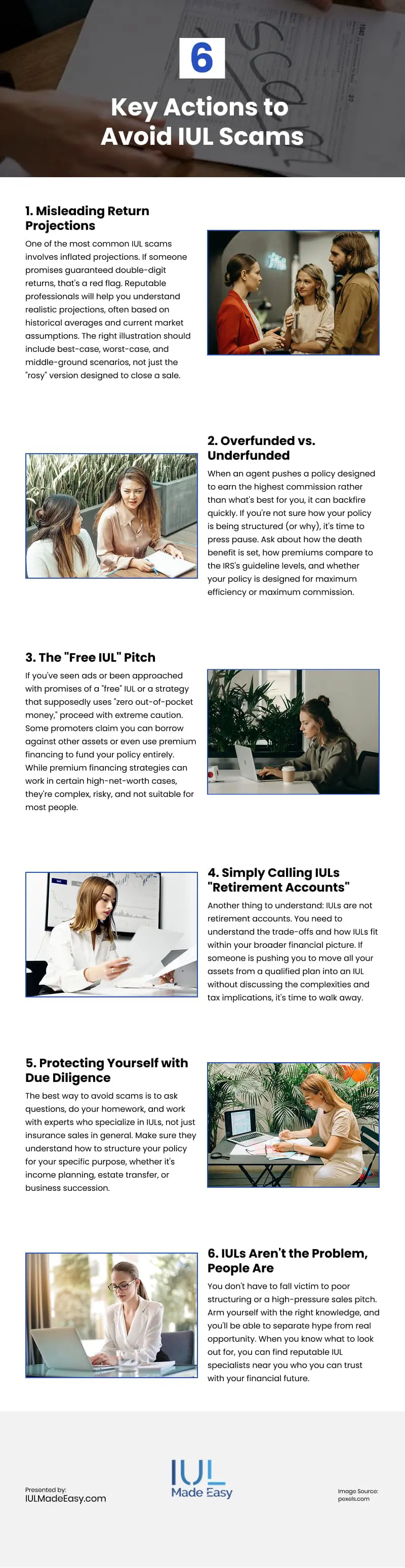
Infographic
If you’re considering an indexed universal life policy, it’s essential to spot misleading pitches and poor structuring that could jeopardize your financial future. Explore this infographic to learn six key actions that help you avoid common IUL scams.